
To plan your trip, also read Alps: which hiking trails should you choose? and Alps: when is the best time to go hiking?.
Quick answer: how do you prepare for hiking in the Alps?
To plan a hiking trip in the Alps, choose a mountain area suited to your experience, check trail conditions and build a programme with recovery days. Book mountain huts if you are walking for several days, pack layers for cold and rain, and consult the mountain weather forecast before every outing. For high-altitude routes without snow, summer is often the best starting point, but trail access depends on the area and the year.
The Alps are not only about difficult summits. You can walk between villages and pastures, reach a lake, stay in a hut or cross several valleys. A successful trip depends less on the number of kilometres covered than on choosing routes that match your abilities and current conditions.
Which Alpine mountain area should you choose?
The Alpine chain crosses several countries and includes very different landscapes. For a first trip, using one valley as your base reduces transfers and makes it easier to adapt walks to the weather.
The areas below are starting points for research, not guarantees of easy terrain. Accessible walks and demanding routes exist within the same mountain range.
| Area | Country | Landscapes and interest | Check before booking |
|---|---|---|---|
| Vercors | France | Limestone plateaus, forests and cliffs | Water access and self-sufficiency on the high plateaus |
| Bauges | France | Pastures, villages and limestone mountains | Steep or exposed sections on the chosen summit route |
| Vanoise | France | Lakes, valleys and a network of huts | Snow on passes and park regulations |
| Écrins | France | Deep valleys and high mountain scenery | The actual difficulty of each route and access conditions |
| Mercantour | France | Mountain lakes, rocky landscapes and heritage | Remaining snow and protected-area rules |
| Chamonix Valley | France | Balcony trails and Mont Blanc views | Local conditions and possible reliance on lifts |
| Dolomites | Italy | Limestone walls, pastures and huts | The difference between a hiking trail and a via ferrata |
| Swiss Alps | Switzerland | Valleys, lakes and many starts reachable by public transport | Trail grading and return timetables |
| Tyrol | Austria | Pastures, valleys and hut-to-hut routes | Stage difficulty and accommodation availability |
Mostly interested in day walks? Compare routes near your accommodation before selecting a region. Planning a trek? Start with the stages and huts, then organise transport.
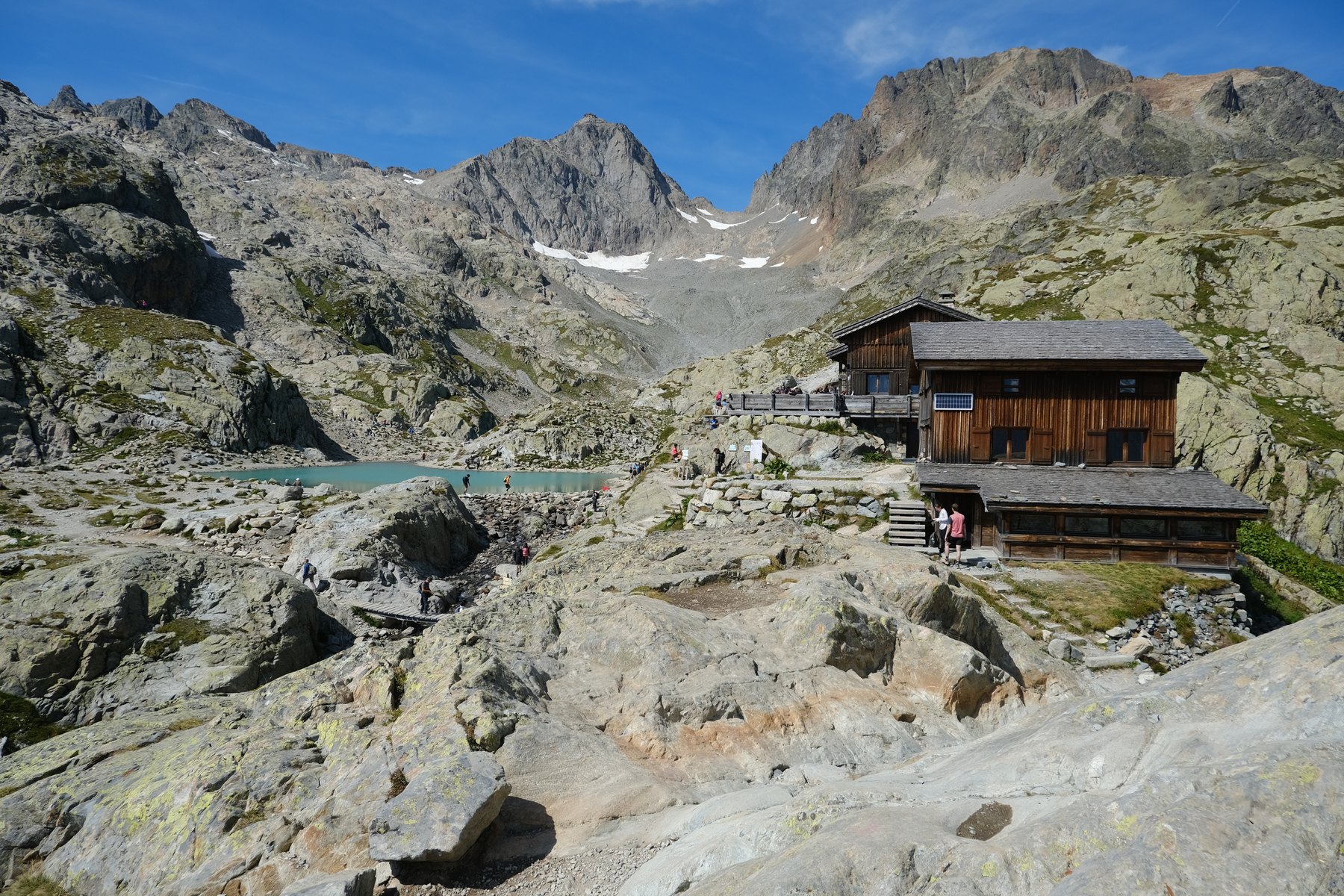
The trail beside Lac Blanc near Chamonix — Guilhem Vellut · CC BY 2.0, license.
.jpg)
When should you hike in the Alps?
No single season suits the entire chain. Altitude, aspect, recent precipitation and latitude affect conditions. A walkable valley trail can lead to a pass that is still covered in snow.
Spring: choose routes that suit actual conditions
Lower-altitude walks can be appealing as snow retreats. High-level crossings do not automatically become accessible when fine weather returns. A hard snow patch, particularly above a steep slope, can make a crossing dangerous.
A recent photograph of a village does not show the condition of a much higher pass. Consult local reports and ask about your specific route.
Summer: a favourable period, with conditions to check
Summer generally opens up more high-altitude walks and hut-based trips. It does not guarantee an absence of snow. In Chamonix, La Chamoniarde explains that good hiking conditions generally arrive around mid- to late June; snow patches may remain afterwards, depending on the year (official trail information).
Heat, thunderstorms and visitor numbers also matter. A long ridge crossing requires particular attention to the forecast.
Autumn: check accommodation and daylight
Autumn can bring beautiful days, but early snow, ice and seasonal hut closures reduce the options. Plan shorter stages and check which services are actually available.
Winter: prepare for a different activity
A summer route does not become an accessible winter walk simply because you own snowshoes. Snow-covered terrain requires specific preparation, including avalanche awareness. For an introduction, choose a suitable outing with a qualified professional.
How do you choose a hike suited to your experience?
Distance alone does not describe an Alpine hike. A short, steep loop can be more tiring than a long walk on an even path.
Before selecting a route, record at least:
- Total distance, ascent and descent.
- Estimated time and what that estimate includes or excludes.
- Maximum altitude and terrain exposure.
- Narrow, equipped, snowy or difficult-to-follow sections.
- Confirmed water points and early exit options.
- Access requirements: road, shuttle, parking or mountain lift.
For a first outing, favour a marked trail without exposed sections and with a straightforward return. Labels such as “easy” and “family-friendly” do not replace the route description. Compare them with your group's abilities, especially when walking with children.
The official Écrins route portal gives distance, duration and elevation information, helping you compare walks on a practical basis. Check local alerts before setting off as well.
The descent deserves as much attention as the climb
Fatigue often becomes noticeable on the return. A long descent strains the legs and may slow the group more than expected. Allow time for breaks, navigation mistakes and changing weather.
Day walks or a hut-to-hut trek?
A fixed base for a gradual introduction
Staying in the same valley for several nights simplifies organisation. You carry a daypack, adapt walks to the weather and can replace a hike with sightseeing or rest.
This approach works well for a first Alpine trip, families and travellers who want flexibility. Check transfer times to trailheads: two valleys may appear close on a map while the road takes a long detour.
Walking from place to place for several days
A trek connects stages and accommodation. It offers a satisfying sense of continuity but needs more planning: pack weight, accumulated fatigue, hut availability and an exit strategy if conditions deteriorate.
Before booking, contact huts to confirm staffing dates, meals, water, payment methods and required equipment. The Deutscher Alpenverein recommends detailed preparation of stages and accommodation for multiday hut walks.
Well-known routes, including the Tour du Mont Blanc, are not automatically the best choice for beginners. A shorter trek matched to your experience may be more rewarding than an overly ambitious famous circuit.
What equipment should you take to the Alps?
Your pack should allow you to walk comfortably and cope with a drop in temperature or a delay. Its contents depend on the duration, terrain and resupply opportunities.
Essentials for a day walk
- Footwear suited to the terrain and already tested.
- Waterproof jacket and a warm layer.
- Sun protection, sunglasses and a hat.
- Water and food appropriate to the route.
- An offline map and navigation tools you know how to use.
- Charged phone and a spare battery if needed.
- Headtorch, emergency blanket and small first-aid kit.
- Personal medication and useful documents.
Walking poles can help on some terrain, but they do not compensate for technical difficulty. Test your pack before travelling: new equipment may become uncomfortable after several hours.
For a night in a mountain hut
Add the equipment requested by the hut, such as a sleeping-bag liner if required, some dry clothing and a small food reserve. Do not assume that showers, electrical sockets or card payments will be available.
If a snowy section requires technical equipment, buying it is only part of the question. You must know how to use it and assess the terrain. For an ordinary summer hike, choosing a different route may be the best decision.
How should you organise transport and accommodation?
Build your trip around the trailheads, not just your arrival city. The final transfer to a village, parking area or hut can determine the whole programme.
For a car-free trip, check connections, seasonal shuttles and the last return departure. If a route depends on a mountain lift, confirm its timetable and operating dates.
If travelling by car, check authorised parking, road restrictions and whether you can leave a vehicle for several days. On a trek, plan how to return to your starting point after the final stage.
For accommodation, compare three approaches: a hotel or rental in the valley, an accompanied trip, or successive nights in huts. The best option depends on your independence and need for flexibility.
What budget should you allow for an Alpine hiking trip?
One universal budget would be misleading: countries, seasons and comfort levels vary considerably. Request prices for your actual dates before comparing destinations.
| Cost | What to include |
|---|---|
| Transport | Return journey, connections, shuttles and parking |
| Accommodation | Number of nights, included meals and any taxes |
| Food | Breakfast, packed lunch, dinner and drinks |
| Access | Lifts or services needed for the route |
| Professional support | Mountain leader or guide appropriate to the activity |
| Equipment | Purchases, hire or replacement items |
| Insurance | Cover matching the country and activity |
| Contingencies | Extra night, changed transport or early return |
To control spending, limit changes of valley and compare packages that include meals. Check insurance terms, especially rescue cover, covered activities and exclusions.
Safety, bivouacking and respect for the mountains
Before every outing, check the mountain forecast, route conditions and local reports. Tell someone your planned route and return time. Decide in advance what would make you turn back.
Conditions can change quickly. La Chamoniarde's field reports are useful for the Chamonix area but do not replace assessment on the ground. Do not continue towards an objective when visibility, snow or the group's condition prevents safe progress.
For emergencies, Mercantour National Park gives 112 as the alert number and notes that mobile coverage is uneven in the mountains. Prepare useful contacts for the country you are visiting and know how to communicate your location, the problem and the number of people involved.
Can you bivouac anywhere in the Alps?
No. Rules vary between countries, municipalities and protected areas. Within the core of Vanoise National Park, bivouacking is restricted to the surroundings of certain huts and to conditions specified by the park. Check local rules, required reservations and permitted dates before taking a tent.
Stay on paths where required, take your rubbish away and keep your distance from wildlife. Near livestock, avoid walking through the animals and follow local advice about livestock guardian dogs.
A sample five-day programme for a first trip
This is a planning framework to adapt to your valley and current conditions. It is not a marked itinerary.
- Day 1: arrival and orientation. Settle in, check access and take a short walk.
- Day 2: first hike. Choose a straightforward route to assess the group's pace.
- Day 3: main outing. Try a longer route if fitness and weather allow.
- Day 4: recovery. Visit a village, rest or take an easy walk.
- Day 5: final short outing. Keep the return compatible with onward transport.
For a first trip, do not fill every day with your most demanding hike. Recovery time improves comfort and makes programme changes easier.
FAQ: planning a hiking trip in the Alps
Are the Alps suitable for beginners?
Yes, with an appropriate route. Choose a marked trail without significant exposure, a realistic duration and a straightforward return. A mountain area's reputation does not tell you how difficult a particular walk is.
What is the best time for an Alpine trek?
Summer is favourable for many high-level summer treks. Exact dates depend on snow, passes and hut opening periods. Check every stage rather than relying on the month alone.
Should you book mountain huts?
It is sensible to book once your stages are defined, especially on popular routes. Confirm cancellation terms and notify the hut if plans change.
Can you hike in the Alps without a car?
Yes, in areas where public transport serves trailheads. Check the final connection, seasonal shuttles and return timetables before booking accommodation.
Is a hike towards a glacier mountaineering?
A path with a view of a glacier may be a hiking route. Walking on the glacier is a different activity with specific risks and skills. Check the precise route and use a professional if necessary.
Do you need a professional to discover the Alps?
Professional support can help with a first trip, navigation and choosing routes. Select someone whose qualifications match the activity and terrain, especially for technical or glacial sections.
What should you check the evening before setting off?
Weather, trail conditions, transport, water, food, accommodation opening and the group's fitness. Prepare a shorter or less exposed alternative as well.