
Hiking in Ireland
Heather hills, glacial valleys and paths above the Atlantic: Ireland is walked on day hikes or multi-day trails, with changeable weather and unusual rules on access to land.
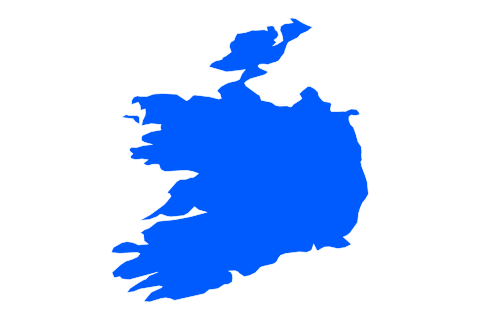
Hiking places
Routes to explore
- Wicklow Way
- Kerry Way
- Dingle Way
Quick answer: where should you go hiking in Ireland?
Hiking in Ireland centres on four regions: the Wicklow Mountains near Dublin, Kerry and the MacGillycuddy’s Reeks in the south-west, and Connemara and Donegal in the west and north-west. The Wicklow Way (about 130 km) and the Kerry Way (about 214 km as a loop) are the best-known long trails, and Carrauntoohil, the country’s highest peak at 1,039 m, is the main summit. May to September brings the longest days, but rain is possible all year. Ireland has no general right to roam: much walking depends on landowners’ goodwill.
| At a glance | |
|---|---|
| Where | Wicklow, Kerry, Connemara, Donegal |
| Who for | All levels on waymarked trails; experience needed on the mountains |
| When | May to September for daylight; year-round with rain gear |
| Suggested length | Day hikes, or 5 to 10 days for a long trail |
| Plan for | Summer bookings, map, waterproofs |
| Watch out for | Hill fog and rain, boggy ground, private land |
Where to go hiking in Ireland
Ireland has no high mountains, but its windswept coastal ranges and blanket bog can make for demanding days. The Wicklow Mountains, an hour from Dublin, suit a first trip. Kerry has the highest peaks. Connemara and Donegal feel wilder and see fewer walkers.
One point often surprises visitors: most land, including the hills, is privately owned. National waymarked trails and national parks are the simplest way to hike without access questions.
Choosing your hiking region in Ireland
Wicklow: the Wicklow Way and Glendalough
The Wicklow Way leaves Dublin’s southern suburbs and crosses the Wicklow Mountains southwards for about 130 km, depending on the source. It is the oldest of Ireland’s long waymarked trails. Stages alternate between moorland, forest and valleys, passing Glendalough, a monastic site set between lakes.
For a day hike, Wicklow Mountains National Park has several loops around Glendalough. A bus from Dublin makes the area reachable without a car; check the timetable before you go.
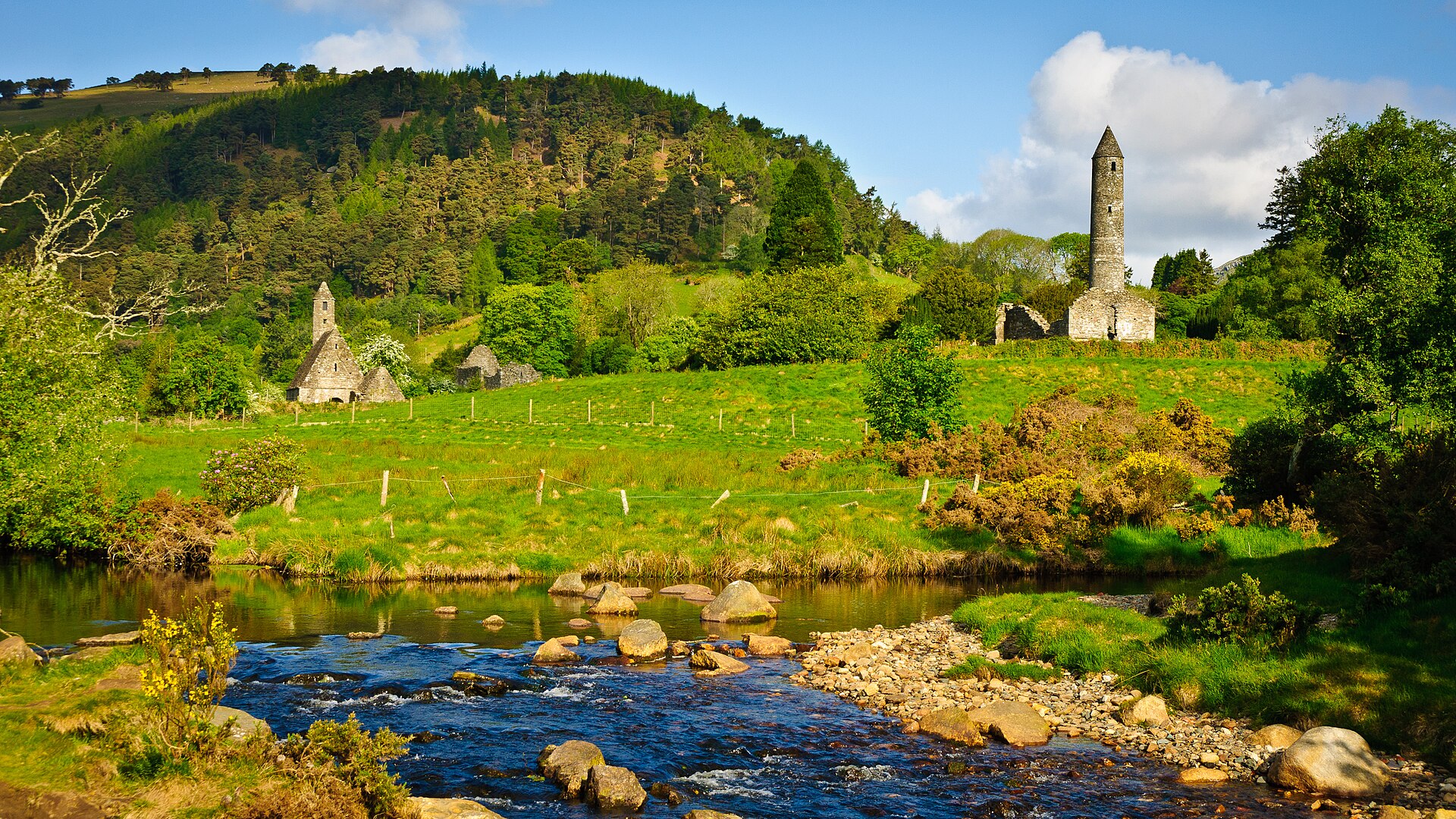
The Wicklow Way near Glendalough — Photo: Joe King · CC BY-SA 3.0.
Kerry: Carrauntoohil, the Kerry Way and the Dingle Way
The Kerry Way, about 214 km long, starts and ends in Killarney as a loop around the Iveragh Peninsula and is usually walked in nine stages. Further north, the Dingle Way circles the Dingle Peninsula from Tralee. Both stay mostly at low altitude.
Carrauntoohil (1,039 m according to Kerry Mountain Rescue) is a real mountain day. The classic route starts at Cronin’s Yard, follows the Hag’s Glen and climbs the Devil’s Ladder, a steep gully. Kerry Mountain Rescue notes that the gully is badly eroded and loose, and dangerous when wet or icy; it suggests allowing about 6 hours for the round trip. Dogs are not permitted on the mountain.
Practical tip: on Carrauntoohil, fog can roll in within minutes. If you cannot navigate with map and compass, go with a local mountain guide.
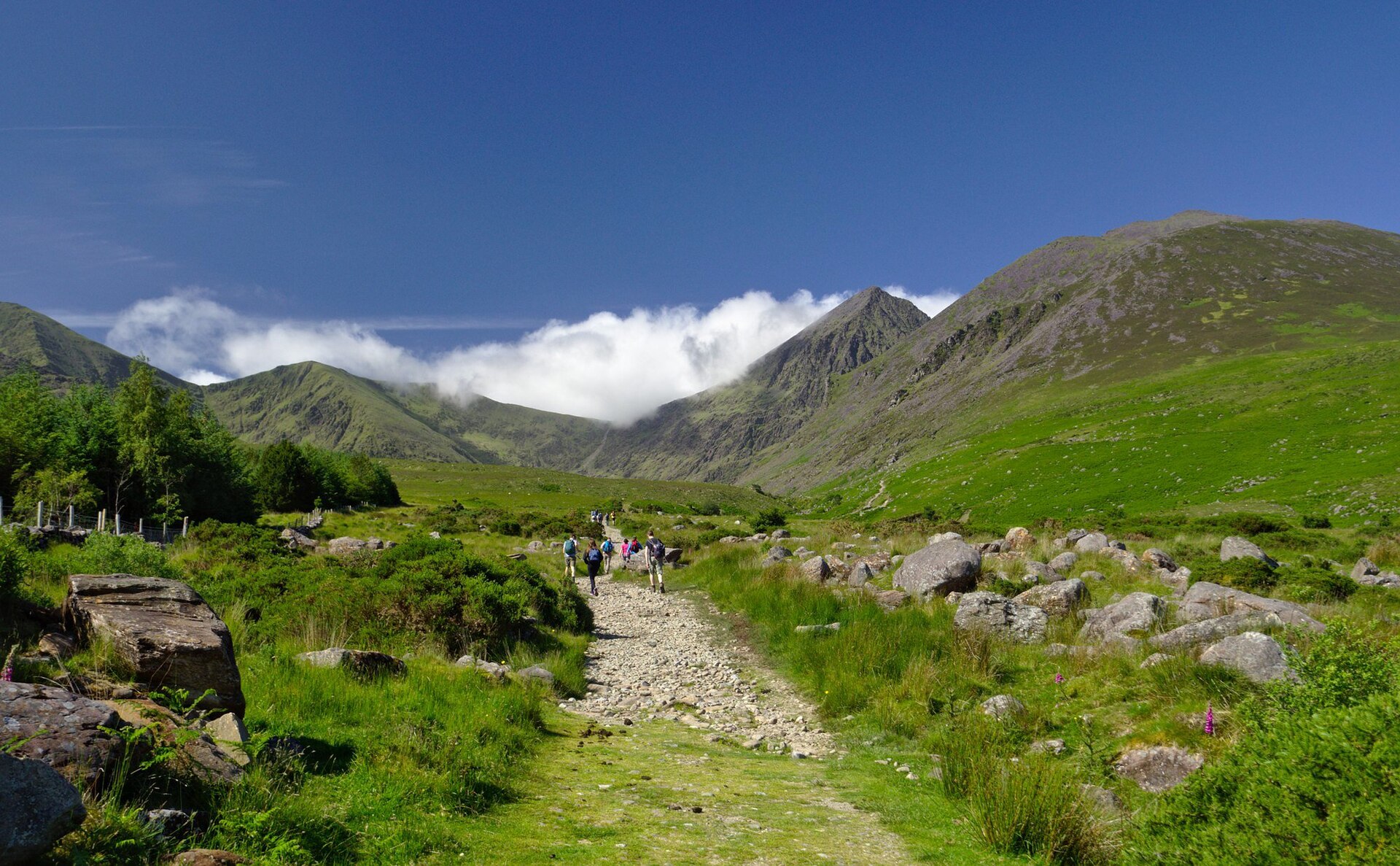
Carrauntoohil seen from the Hag’s Glen — Photo: Mariusz Z · CC BY-SA 2.0.
Connemara: Diamond Hill and the Twelve Bens
Connemara National Park, near Letterfrack, has a visitor centre where the Diamond Hill trails begin. The summit looks over the Twelve Bens, lakes and the coast. It is a well-built walk of a few hours and a good first day.
The Twelve Bens and the Maumturks, to the south, are more serious: rocky ground, little waymarking and navigation skills required.
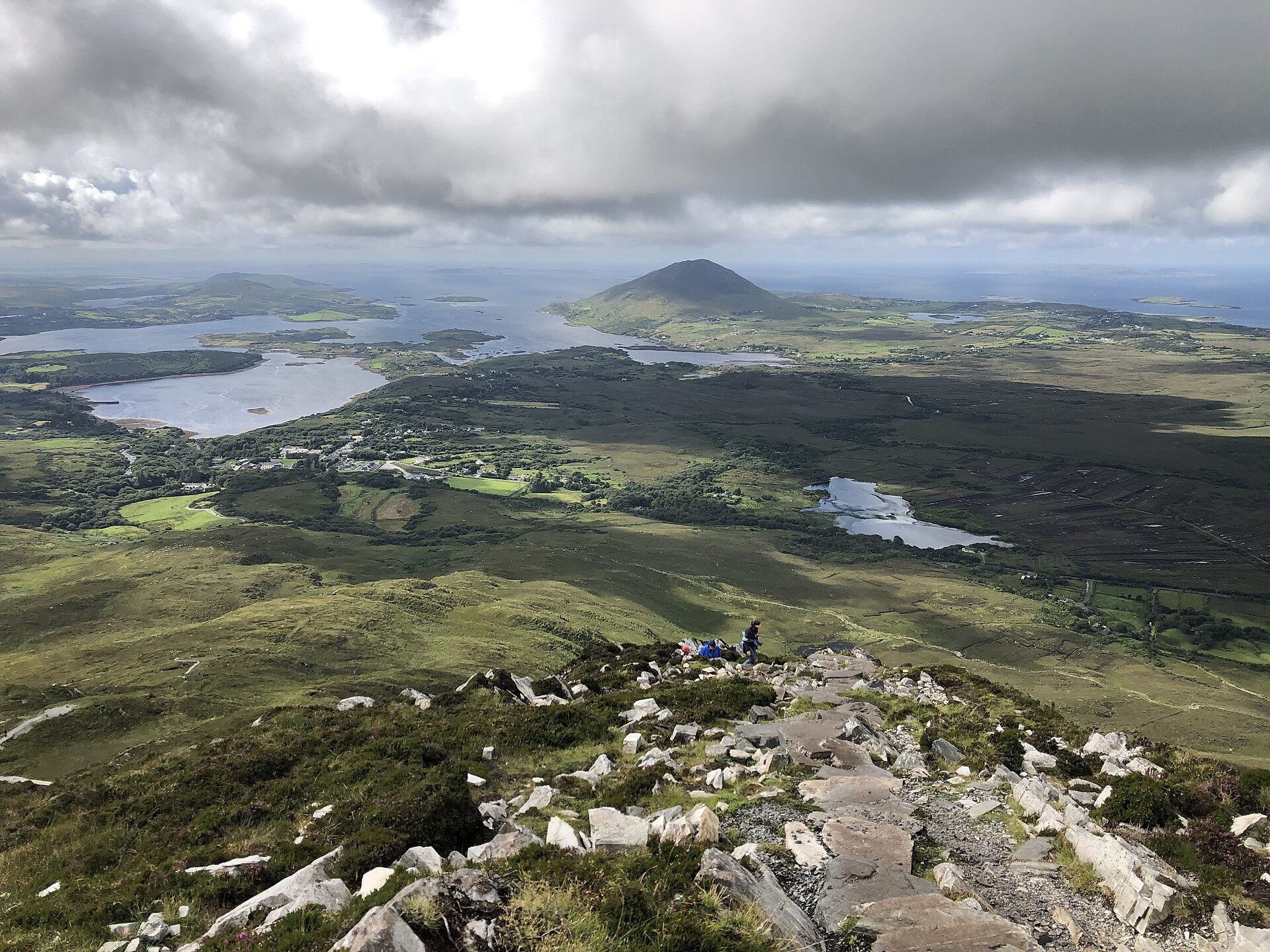
Hikers on Diamond Hill in Connemara National Park — Photo: Karie Kuiper · CC BY-SA 4.0.
Donegal: Glenveagh, Errigal and Slieve League
In the north-west, Donegal combines Glenveagh National Park, the quartzite cone of Errigal and the high sea cliffs of Slieve League. Distances between sites are long: a car or a two-base itinerary keeps the trip simple.
When to go hiking in Ireland
May to September brings the longest days and mild temperatures. July and August are also the busiest months, so book accommodation along the long trails early. April and October are quieter, with shorter days.
Rain can fall in any season, and wind is often strong on the ridges. Winter hiking works at low level, but days are short and summits are sometimes snow-covered.
To compare with other destinations, see our month-by-month calendar of the best time to go hiking.
Access, logistics and waymarked trails
- Land access: Ireland has no general right of access to the countryside. Stay on waymarked trails, respect signs and ask permission off-trail.
- Waymarked trails: Sport Ireland keeps the national register, with lengths, times and grades.
- Accommodation: B&Bs and hostels line the Wicklow Way and Kerry Way; several companies offer baggage transfer.
- Emergencies: call 112 or 999 and ask for Mountain Rescue.
Gear and respect
Pack a waterproof jacket and trousers, waterproof boots, warm layers and a paper map, as phone coverage drops in some valleys. Wet bog makes low shoes uncomfortable.
Close gates, keep dogs on a lead where they are allowed, and do not disturb sheep, especially in spring.
Frequently asked questions about hiking in Ireland
What is the best hiking trail in Ireland for beginners?
The Wicklow Way, thanks to its waymarking, closeness to Dublin and accommodation, suits a first multi-day walk. For a day hike, Diamond Hill in Connemara is a good choice.
Can you hike anywhere in Ireland?
No. There is no general right to roam: most land is private and access relies on landowners’ goodwill. Follow waymarked trails.
Is Carrauntoohil suitable for beginners?
It requires good fitness and navigation experience. The Devil’s Ladder is steep and loose; in poor weather, a guide is recommended.
What is the best time of year?
May to September for long days. Rain is possible in every season.
Do I need a permit to hike?
No. Follow national park rules and local restrictions, such as those on dogs.
Sources
Checked on 10 October 2026: Sport Ireland, trails; Kerry Mountain Rescue, Carrauntoohil routes; National Parks of Ireland, Connemara; Oireachtas, parliamentary answer on countryside access.